Albert is the name of the French state’s artificial intelligence, developed since 2023 by DINUM, the French government’s interministerial digital agency. It is not a ChatGPT open to everyone: in 2026, Albert mainly means Albert API, a technical service reserved for French central government staff, and the chat assistant for public servants is now called L’Assistant. Members of the public and companies, in France or elsewhere, cannot use it on their own behalf.
Everything below was checked on 22 October 2026 on DINUM’s official pages, which are in French (quotes are translated): these services change quickly.
What is Albert today?
Two services carry on Albert’s legacy.
Albert API is a technical gateway: French administrations’ applications connect to it to use AI models without sending their data to the companies that publish those models. DINUM describes it as “the reference interministerial API for accessing generative AI models” (ia.numerique.gouv.fr, in French). It is aimed at teams building tools, not at public servants who want to chat with an AI.
L’Assistant (“The Assistant”) is the chat tool: a “conversational assistant operated by DINUM so that public servants can talk to generative AI models in a secure environment” (ia.numerique.gouv.fr, in French). It used to be called Albert Conversation. Launched in October 2025 for 10,000 public servants, it is due to be rolled out “to all public servants before the end of 2026”, according to a French government announcement of June 2026 on info.gouv.fr. It is also built into Docs, the text editor of La Suite numérique, the French state’s own suite of collaborative tools.
What stopped: Albert in France services centres
Albert first became known through a trial: from January 2024, advisers in France services centres (local one-stop shops where people get help with public-service paperwork) used it to prepare their answers to the public. The adviser always gave the answer, not the AI. Gabriel Attal, then Prime Minister, announced on 23 April 2024 that it would be rolled out to all centres.
On 9 January 2026, DINUM said this tool would not be rolled out “in its current form”, according to an AFP news report. It added that “most of the experimental projects grouped under the Albert brand have now been made permanent”. In other words, Albert has not disappeared: it is Albert in France services centres that stopped.
Who can use Albert?
| Service | Who for | Price | Login |
|---|---|---|---|
| Albert API | employees of the French central government civil service and the bodies it oversees | free for central government staff, with quotas; a higher tier is co-funded by partner ministries | ProConnect |
| L’Assistant | central government departments and the bodies they oversee (access is opened department by department, not person by person) | free, no quota | ProConnect |
| Members of the public, companies | no | — | — |
ProConnect is the French state’s login system for professionals.
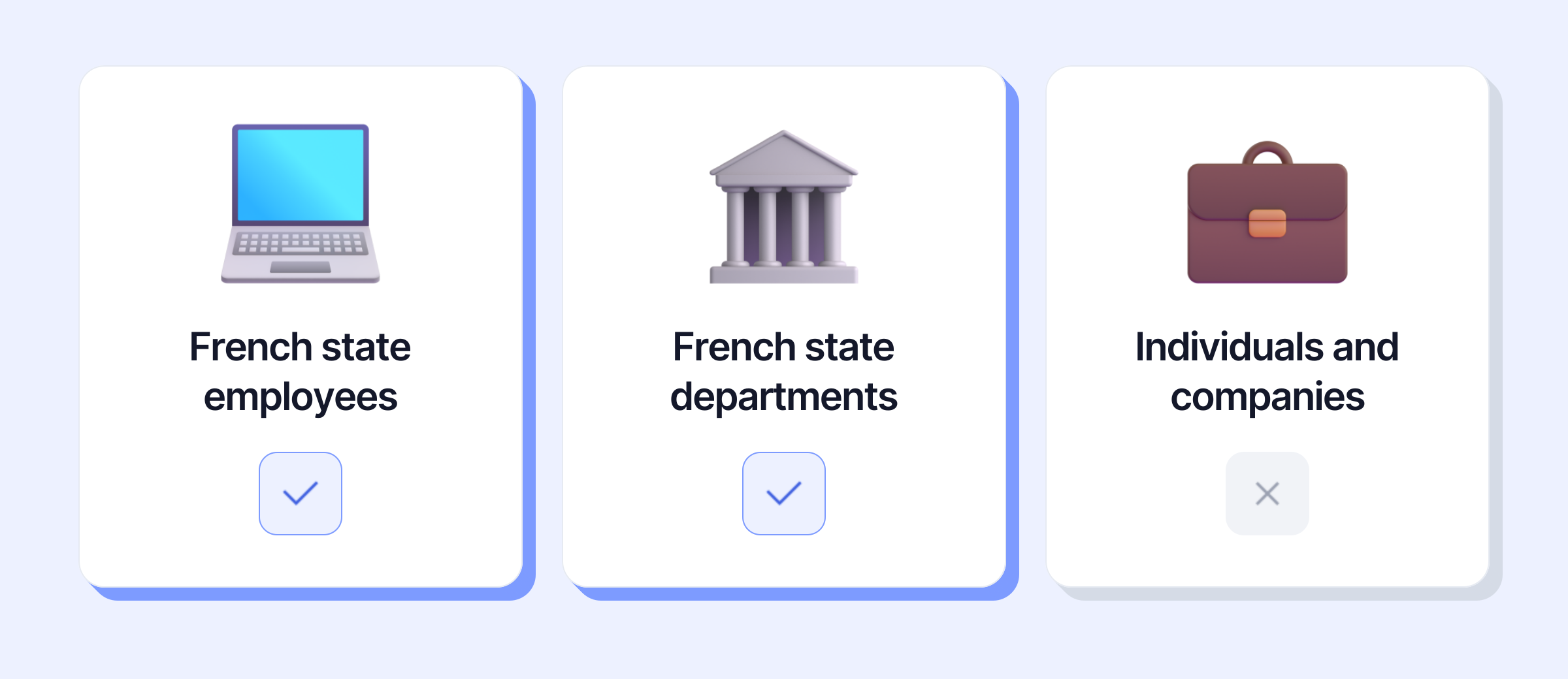
French local authorities (regions, départements, towns) are not eligible in principle. The Albert API documentation allows an exception, on request, when the state jointly oversees the body.
For companies, the rule is written in black and white: Albert API “is a service reserved for employees of the state civil service. A company therefore cannot use it on its own behalf or resell it”. It can only let its public-sector clients connect to it with their own credentials (official guide, in French).
Which AI models does Albert run?
DINUM does not train its own models: it runs existing models, published openly, on its own servers. As of 22 October 2026, the official Albert API list includes gpt-oss-120b (published by OpenAI), Mistral Small 3.2 and Ministral 3 (Mistral AI), and Whisper for turning speech into text. The main model behind L’Assistant is Mistral Medium 3.5.
This list changes: two models are due to be withdrawn by 1 December 2026 and replaced. DINUM states that “none of your data is sent to these model providers or used to train them”.
Where does the data go?
- Hosting: Albert API runs at Outscale, whose SecNumCloud qualification DINUM highlights (SecNumCloud is the cloud security standard of ANSSI, France’s national cybersecurity agency), and on Nubo, the private cloud of the DGFiP, France’s tax administration.
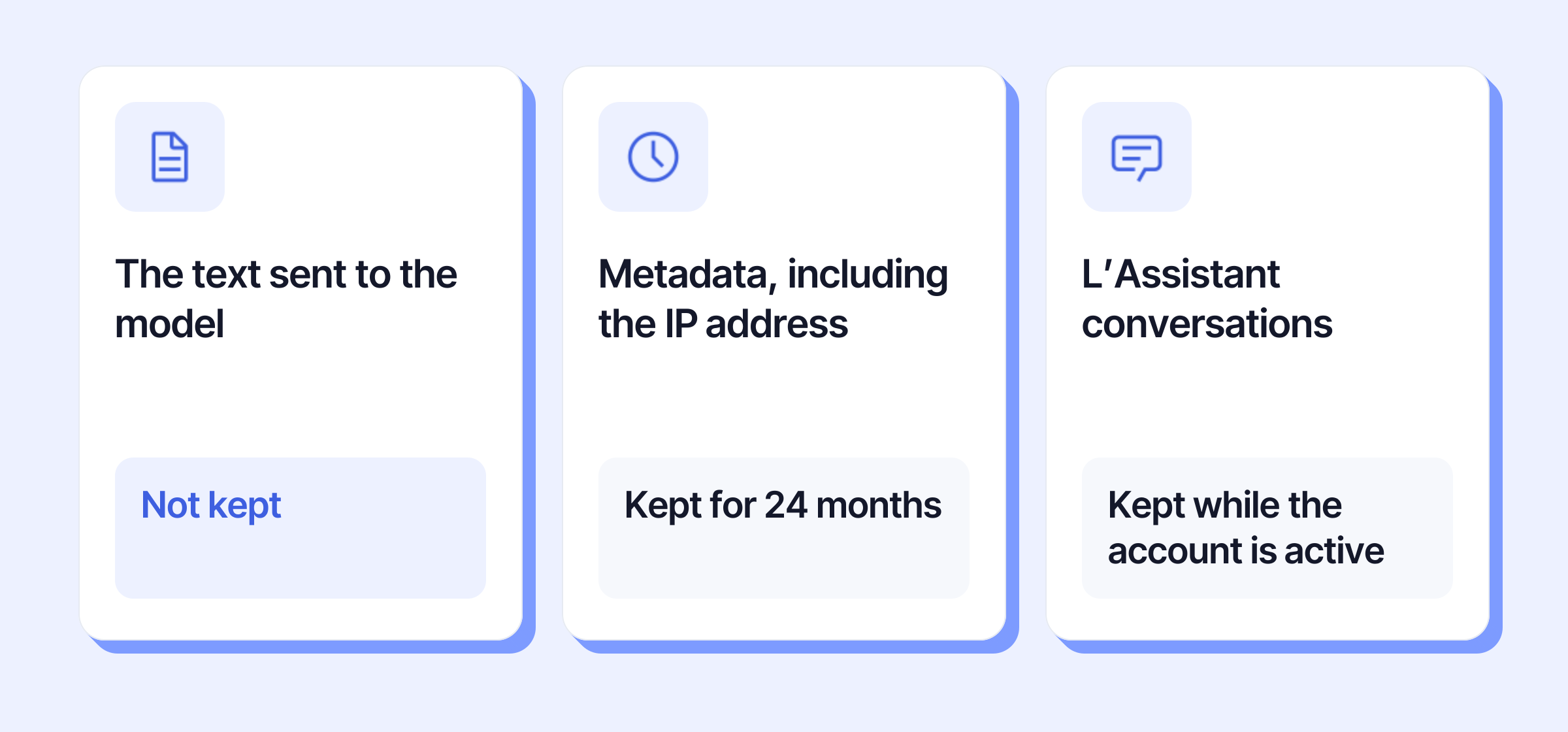
- The content of requests is not kept. The official note of 2 September 2026 describes a “zero data retention” offer: the text sent to the model is not written to any lasting storage.
- But not everything is deleted. The same note says that “non-retention covers the content, not the existence of the calls”: metadata, including the IP address, is kept for 24 months. Documents uploaded to search through are not covered by this non-retention.
- L’Assistant keeps conversations for as long as the public servant’s account is active.
Can French public servants use ChatGPT instead?
Rarely. The AI usage guide for central government public servants, published in June 2026 by DINUM and two other French government departments (DITP, in charge of public-sector transformation, and DGAFP, in charge of the civil service), puts it this way: “Using a commercial tool (ChatGPT, Claude, Gemini...) must remain exceptional and is only possible if both conditions are met: your administration explicitly allows it; the information processed could be freely published on the internet.” The guide says it has no regulatory force, but it sets out the state’s position.
What if you don’t have access to Albert?
You won’t be able to use Albert itself, but part of what it is made of is open to everyone:
- The code is open source. The software behind Albert API (OpenGateLLM) and behind L’Assistant is published under the MIT licence. La Suite numérique says that an organisation that isn’t eligible can “deploy its own instance and run it under its own responsibility”. You need a technical team and servers for that.
- The models can be downloaded. Those on Albert’s list are published on Hugging Face under open licences (Apache 2.0 for most of them): you can run them on your own machines.
- There is a French assistant open to the public: the one from Mistral AI, a French company, now called Mistral Vibe (formerly Le Chat). It has a limited free plan and paid plans. Its terms for individual users say your conversations are used to train its models unless you switch this off (terms dated 8 October 2026).
If your question is a business one (“which AI can I give my team without exposing our data?”), the business plans are compared in ChatGPT for business.
Pitfalls to avoid
- Websites offering to “try Albert”. There is no Albert open to the public: official access goes through ProConnect, with a French state employee account. An unofficial site that borrows the name offers none of DINUM’s guarantees.
- Articles from 2024. They describe models “specifically trained for the needs of the administration” and announce Albert in every France services centre: that is no longer the case.
- Confusing sovereign with confidential. Albert is hosted in France and doesn’t keep the content of requests, but it does keep traces that they happened. Each administration’s own usage rules still apply.
To go further on AI hosted in France and in Europe: the sovereign resources.