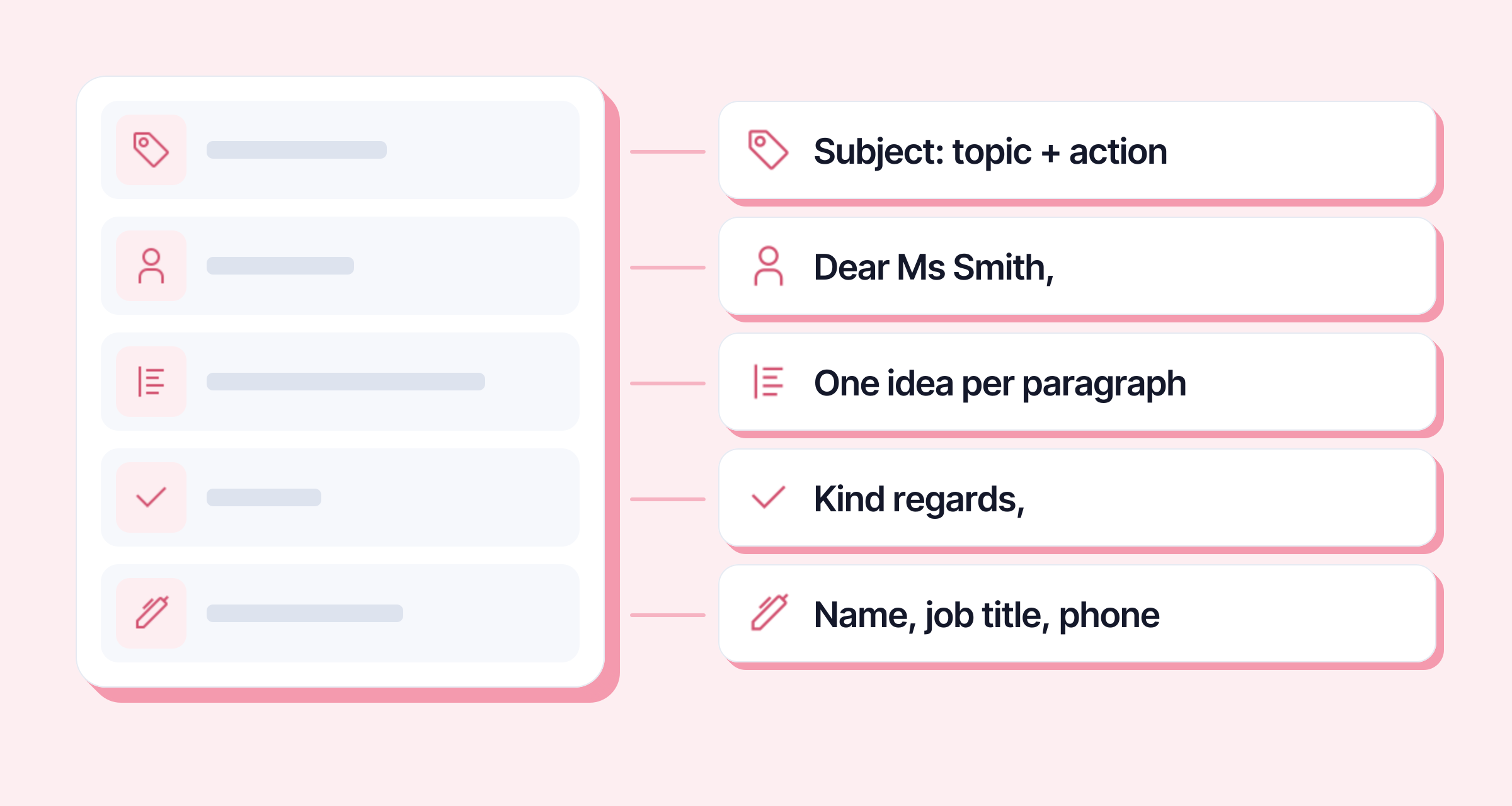
A professional email has five parts: a subject line that states the topic and what you need, a greeting suited to the recipient, a short body that starts with the main point, a sign-off, then your signature. The test is simple: from the subject line and the first sentence, your reader should know what you want from them, and by when. Everything else is useful detail.
The structure of a professional email
| Part | What it should do | Example |
|---|---|---|
| Subject line | state the topic and the action needed | Quote no. 2026-118: approval needed by 30 Oct |
| Greeting | address the right person, in the right tone | Dear Ms Smith, |
| Body | main point first, one idea per paragraph | Please find attached the quote… |
| Sign-off | close and say goodbye | I’m happy to discuss it. Kind regards, |
| Signature | say who you are and how to reach you | First name Last name, job title, company, phone |
The subject line: the topic and what you need
The subject line is the only line your reader is sure to read. It decides whether your email gets opened now, later, or found three weeks from now through a search.
- A vague subject gets lost: “Question”, “Following up”, “Important”.
- A good subject names the topic, then the action: “Budget meeting 4 Nov: agenda to approve”, “Invoice 2026-0412: reminder”, “Application: Executive Assistant, ref. AD-26”.
- Include the date or reference when there is one: it’s what people type in the search bar.
- Change the subject when the topic changes. A “Re: Re: Re: Schedule” thread that is now about an invoice will never be found.
The greeting
It depends on what you know about the recipient, and on the tone of your exchanges.
| You’re writing to… | Greeting |
|---|---|
| Someone whose name you don’t know | Dear Sir or Madam, |
| Someone you haven’t met yet | Dear Ms Smith, |
| A regular client or partner | Hi Claire, (if they use your first name) |
| A colleague | Hi Sam, |
| A public body, a recruiter | Dear Sir or Madam, or Dear Ms Smith, |
Three habits to keep in mind:
- A comma after the greeting, then a line break. The body starts with a capital letter.
- “Hello” on its own works when you write to a generic address (info@, accounts@).
- Let the recipient set the tone. If they switch to first names or sign off with a simple “Thanks”, you can follow. Rarely the other way round.
Writing to French contacts? French has its own greetings and sign-offs (Madame, Monsieur, Cordialement…): see what Cordialement means and how to sign off a French email.
The body: main point first
Most work emails are skimmed, often on a phone. Write for that kind of reading.
- First sentence: why you’re writing. “Please find attached the quote for your website redesign.” Not two lines of “I’m just reaching out to follow up regarding…”.
- One idea per paragraph, three or four lines at most. If you have three questions, number them: you’ll get answers point by point.
- The request, in plain words, with a deadline. “Could you confirm you’re happy to go ahead by Thursday 29 October?” rather than “Let me know if you have any questions”.
- Name the attachments in the text: “I’ve attached the quote (PDF, 2 pages).” It forces you to check they’re there.
- A closing sentence that says what happens next: “I’ll call you on Monday if I haven’t heard from you by then.”
Keep a slightly formal tone by default with a client, a supplier or a senior manager you don’t already know well: full names, no slang, no jokes. Once the email is written, read it again and ask yourself: what can I cut?
The sign-off
It works in two steps: a sentence that wraps up, then the sign-off itself.
| Situation | Sign-off |
|---|---|
| Most work emails | Kind regards, |
| An ongoing exchange, a little warmer | Best regards, or Best wishes, |
| A colleague or a close contact | Thanks, or Have a good weekend, |
| A formal tone (senior management, a key client) | Yours sincerely, |
| A letter that starts with Dear Sir or Madam | Yours faithfully, |
Avoid abbreviations (“Rgds”, “BR”): they save two seconds and suggest you couldn’t spare those two seconds for the reader.
The signature
Four lines are enough: first and last name, job title, company, a phone number. Add your address or a link only if it helps the recipient. A twelve-line signature with three logos and a quote is hard to read on a phone.
In Outlook and in Gmail alike, you set up your signature once in the settings, and it is then added automatically.
The mistakes that cost the most
- “Reply all” by reflex. Before sending, look at the list: who actually needs your reply?
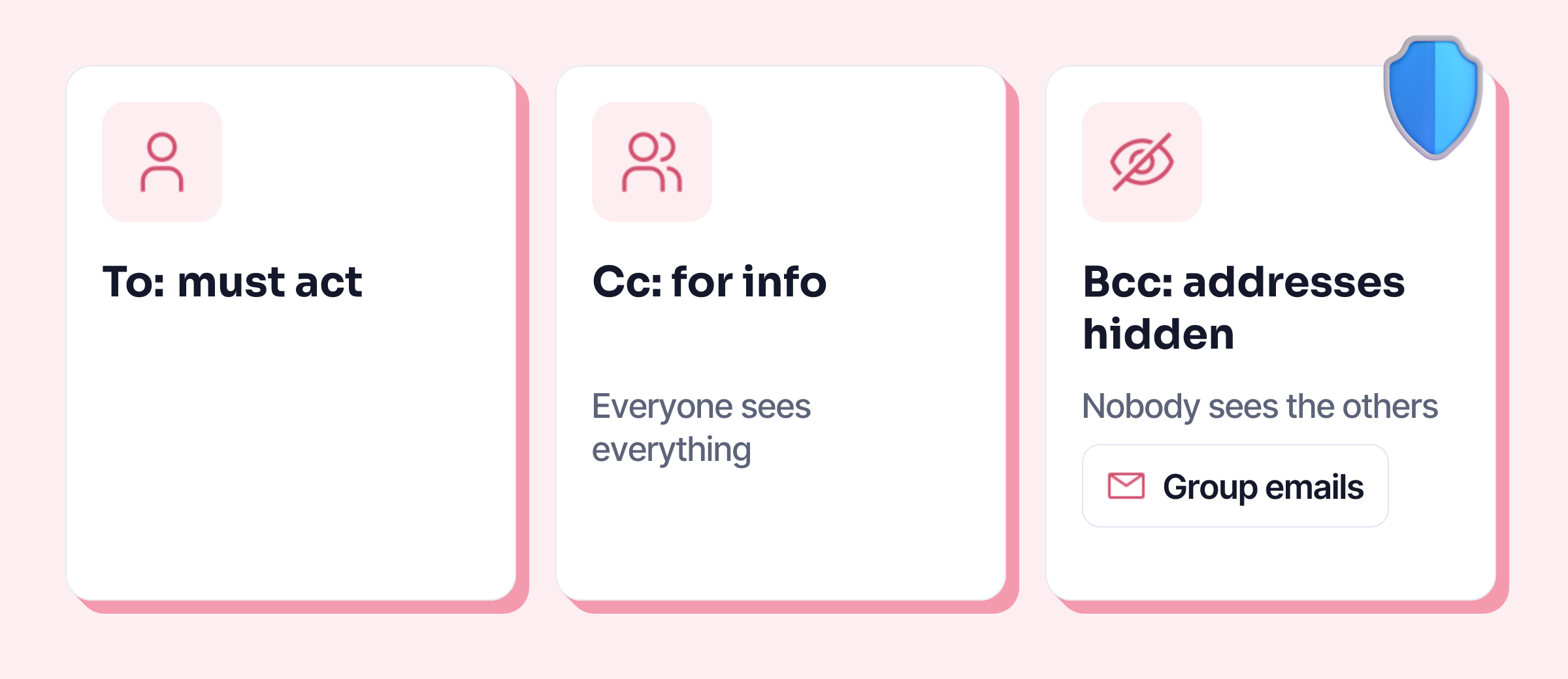
- Cc instead of Bcc for a group email. In Cc, every recipient sees everyone else’s address. To write to people who don’t know each other (clients, candidates, attendees), put them in Bcc: their addresses stay hidden. The CNIL, France’s data protection authority, counts an email address as personal data (CNIL definition, in French): sharing it with everyone is not a small thing.
- The attachment you mentioned and forgot. Attach the file before you write the text.
- The email written in a moment of irritation. Write it, leave it in drafts, read it again an hour later. A firm request can stay polite.
- Typos. A typo in a name or an amount does more damage than a missing comma. Run a spell check before you send.
- Filling in the recipient first. Fill in the “To” field last: an email with no recipient can’t go out by accident.
Following up without being pushy
A follow-up stays in the original thread (so the reader has the context), restates the request in one sentence and suggests a new deadline:
Dear Ms Smith,
I’m following up on the quote I sent on 20 October. Could you let me know whether it works for you, or whether it needs adjusting? A reply by 6 November would let me book the team’s dates.
Kind regards,
James Moreau
And if you’re the one going away, set up your out-of-office message in Outlook before you leave.
An example: before and after
Before
Subject: quote
Hello,
I’m just reaching out to follow up on our conversation last week about your project, as agreed I’m sending you the quote, there are a few options we hadn’t discussed that might interest you, don’t hesitate if you have any questions.
Rgds
After
Subject: Website redesign quote: approval needed by 30 Oct
Dear Ms Smith,
As agreed on Thursday, here is the quote for your website redesign (PDF attached).
It covers the three pages we discussed. I’ve added an optional French translation, priced separately: you can remove it without changing anything else.
Could you confirm you’re happy to go ahead by Thursday 29 October? We could then start on 4 November.
Kind regards,
James Moreau
Project Manager, Moreau Studio
07700 900123
What changed: the subject says what and by when, the first sentence says why you’re writing, the option is explained in one sentence, the request has a date, and the signature says who is writing.
Write your emails faster
With Keypop, you select your draft in Outlook, Gmail or any other app, press Alt + K, then ask it to proofread the text or make it more diplomatic. On the free plan, local AI does the work, on your computer; all you need is a free account with your email.