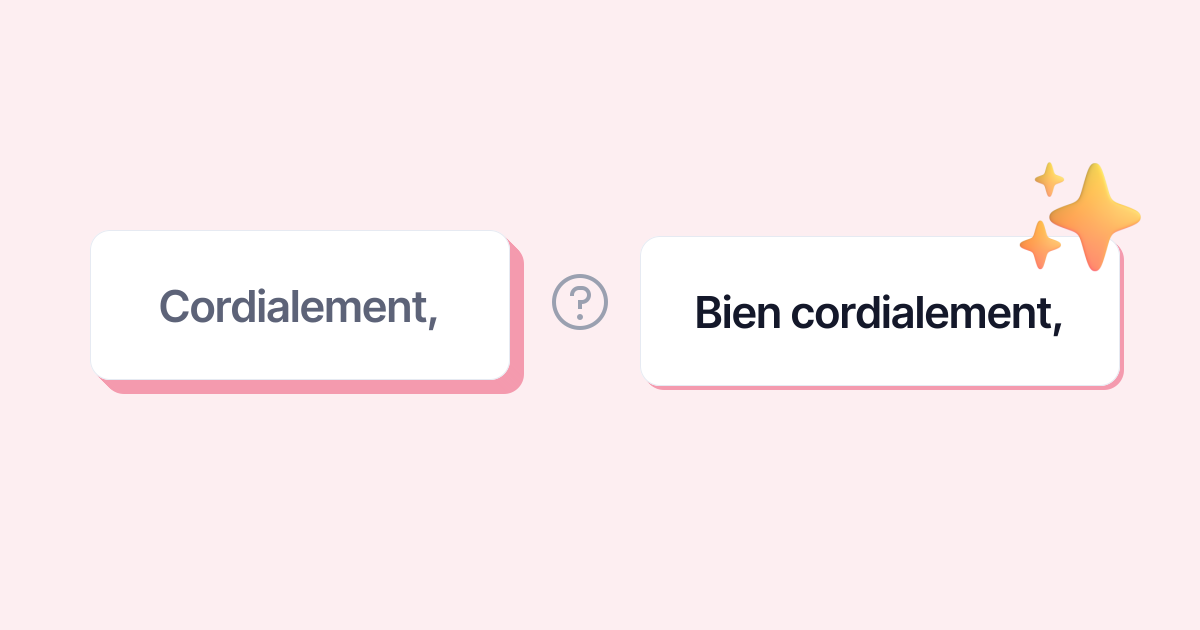
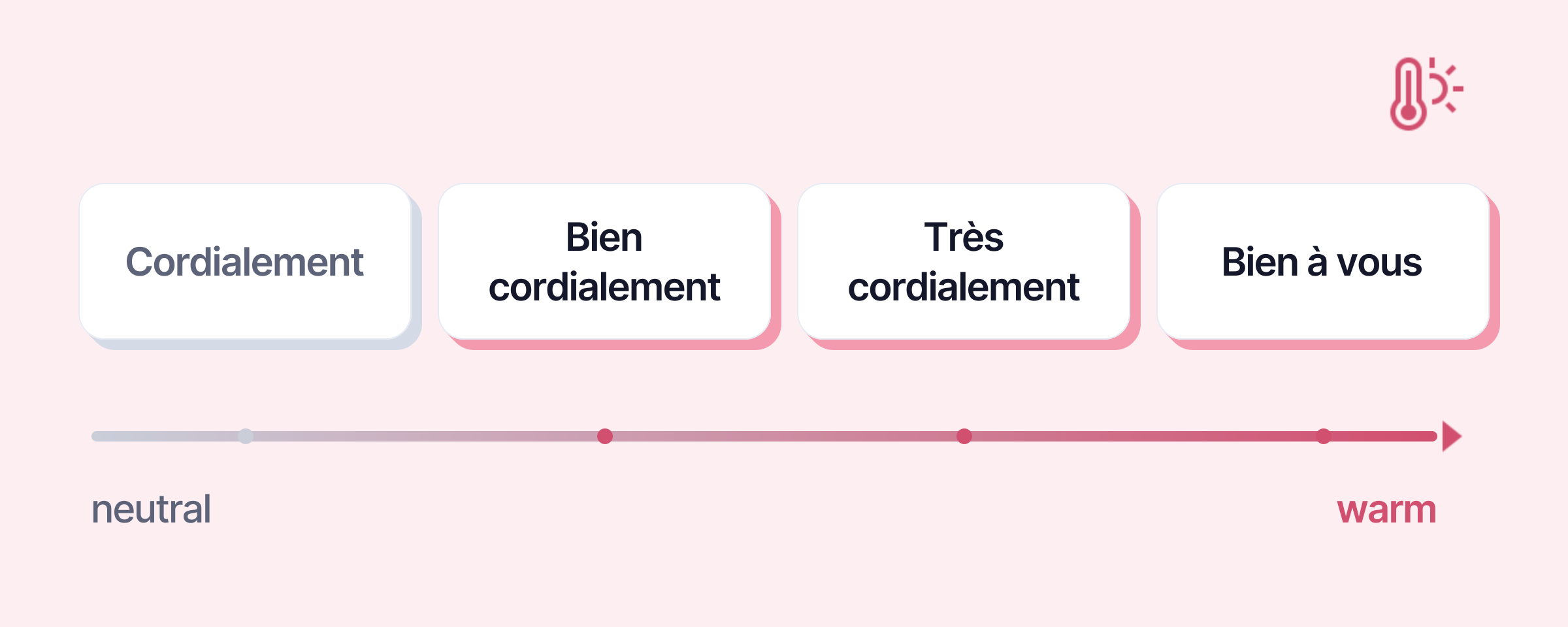
Cordialement (roughly “cordially”) is the standard way to sign off a French work email: it is neutral, almost administrative, close to “Regards” in English. Bien cordialement adds warmth without being familiar, like “Kind regards” or “Best regards”, and it is the safest choice with a client, a manager or a colleague you don’t know well. For a French government office or a job application, use neither: French keeps a long formal closing for those.
These are habits, not official rules: what follows is what most French office workers read as polite, or as curt.
What do Cordialement and Bien cordialement mean?
Cordial comes from the medieval Latin cordialis, “relating to the heart” (CNRTL etymology, in French). Signing Cordialement is a way of greeting someone with goodwill. But because it is used everywhere, the word alone has lost its warmth: it has become the default sign-off, the one people type without thinking. Bien (“well”, here “very”) gives it back.
| French sign-off | What it says | When to use it |
|---|---|---|
| Cordialement, | neutral, a little curt | first contact, factual exchange, generic address (contact@, compta@) |
| Bien cordialement, | polite and warm, not familiar | most work emails: client, manager, partner |
| Très cordialement, | one notch warmer | someone you like working with, an ongoing relationship |
| Bien à vous, (“yours”) | more personal, a touch of elegance | someone you have already exchanged with |
| Sincères salutations, (“sincere greetings”) | short but formal | when Cordialement feels too light |
What is the English equivalent?
The closest equivalents are “Kind regards” or “Best regards” for Bien cordialement, and “Regards” for Cordialement (WordReference). “Regards” on its own is as neutral as its French cousin.
So if you receive an email signed Cordialement, don’t read anything into it: it is the French “Regards”, not a sign of coldness. If you are writing in French, Bien cordialement is the one to reach for when you would write “Kind regards” in English.
When should you write Bien cordialement?
When in doubt, use this one. It suits:
- a client or a prospect, from the second email, and often from the first;
- your manager or senior management, in everyday emails;
- a partner or a supplier you work with regularly;
- a reply to someone who signed Bien cordialement: you match them.
A slightly too polite email is always forgiven. A curt one, less so.
When is Cordialement enough?
Cordialement on its own is not rude. It is even the right choice when the message is purely practical: confirming a meeting, sending a requested document, replying to a customer service team. It turns curt in two cases:
- with someone you know well: after ten friendly emails, a plain Cordialement sounds like things have cooled down;
- after a delicate request or a disagreement: it can read as irritation, even if you didn’t mean it.
The other way round, if your contact switches from Bien cordialement to Cordialement, don’t assume anything: many people alternate without thinking.
How to reply to someone who signs Bien cordialement
Match them, or go one notch warmer. If they sign Bien cordialement, reply with Bien cordialement or Très cordialement. If they move to Bonne journée (“have a good day”) or just their first name, you can follow on your next message: they set the tone of the relationship.
French has two words for “you”: the formal vous and the informal tu. With a colleague you call tu, the sign-off follows: Bonne journée, À plus tard (“talk later”), Bien à toi. A Bien cordialement at the bottom of a tu message looks odd.
Comma, capital letter, signature
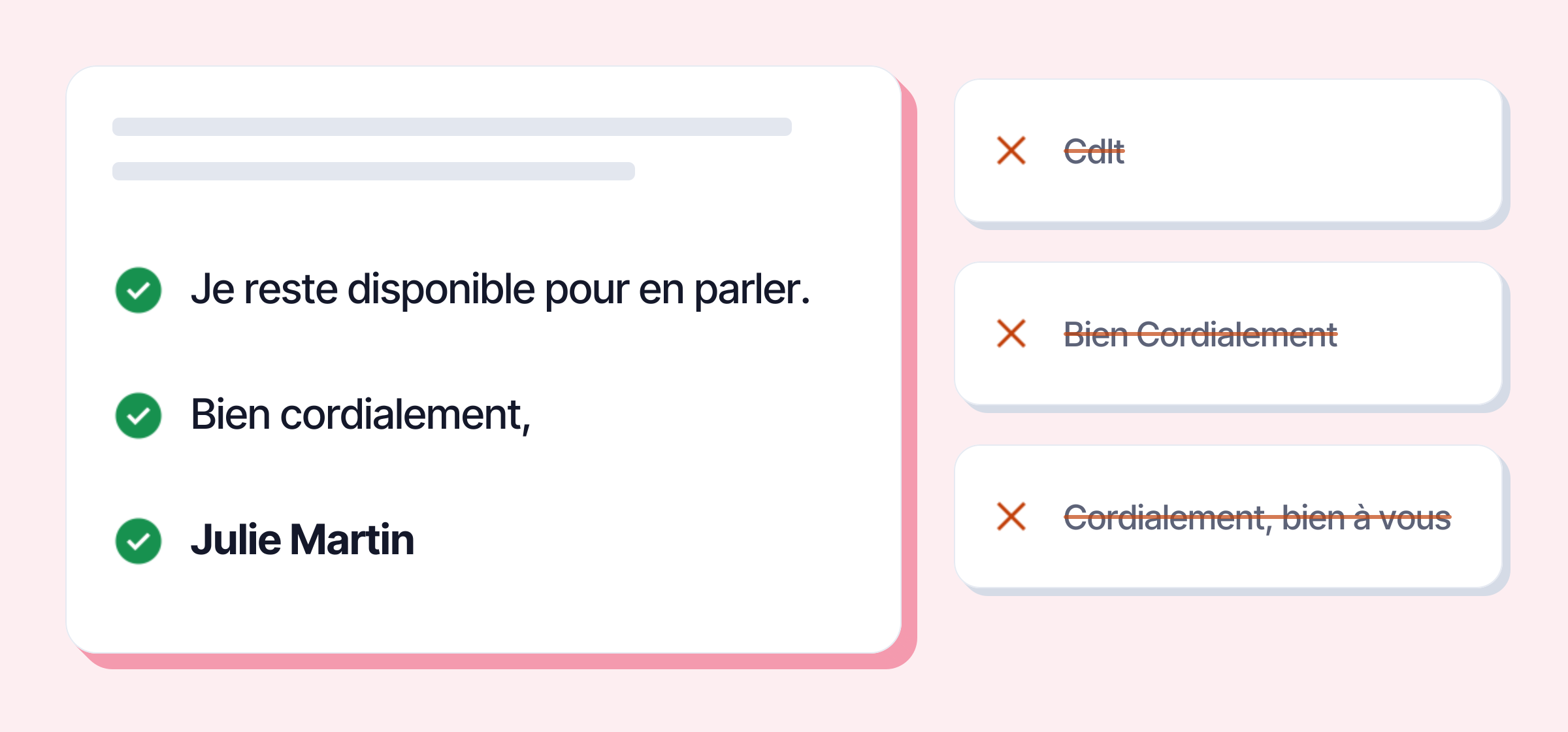
- A closing sentence first, if you have one: Je reste disponible pour en parler. (“I’m happy to discuss it.”) It ends with a full stop.
- Then the sign-off on its own line, with a comma: Bien cordialement,. This is the most common practice in emails.
- A capital on the first word only: Bien cordialement, not Bien Cordialement.
- Your signature on the next line: first and last name, then your job title if needed.
- One sign-off only. Cordialement, bien à vous or Bien cordialement et bonne journée stack two endings for nothing. If you want to wish someone a good day, put it in the closing sentence.
Three mistakes to avoid:
- Abbreviations: Cdlt, Bien cdlt, Bàv. They save two seconds and suggest you couldn’t spare those two seconds for the reader.
- Cordialement vôtre (“cordially yours”): you still see it, but it sounds dated. Bien cordialement says the same thing.
- Bien cordialement after a long formal closing: Je vous prie d’agréer… l’expression de mes salutations distinguées stands on its own.
What about a government office or a job application?
Neither Cordialement nor Bien cordialement. For the tax office, a town hall, a pension fund or a recruiter, the long formula is still the norm, even by email:
Dans l’attente de votre réponse, je vous prie d’agréer, Madame, Monsieur, l’expression de mes salutations distinguées.
(Roughly: “I look forward to your reply. Yours faithfully.”)
Repeat your opening greeting between the two commas: if you wrote Madame la Directrice, (“Dear Director”) at the top, write je vous prie d’agréer, Madame la Directrice, ….
The traps
- Polishing the sign-off instead of the email. A Bien cordialement won’t rescue a curt message: the sentence before it sets the tone.
- Copying the other person’s sign-off blindly. If they write Bises (“kisses”) to a client, don’t follow.
- Changing sign-off mid-thread for no reason: people will wonder what happened.
For the rest of the email (subject line, greeting, body), everything is in how to write a professional email.
And if your whole message sounds too curt, select it in Outlook, Gmail or any other app, press Alt + K and ask for a more diplomatic version: Keypop keeps your request and rewrites it in a courteous tone. Local AI is free; all you need is a free account with your email.